



Names Throughout History
•
Thought Reading
•
Thought Transference
•
Telepathy
•
Mental Radio
•
Mental Suggestion
•
Telepsychic Transmission
Definition
In X-Men from the Marvel Universe, Professor Charles Xavier has the ability to perceive and send thoughts and sensations—at a distance and without using words. He uses this ability to silently communicate with other minds (human and non-human) and even to manipulate them, for example by influencing bodily functions and inducing mental illusions or hallucinations (Vactor, 2024).

In the widest scope, this fascinating ability is telepathy. And as the ancient historical cross-cultural reports, modern day reports, and even controlled science experiments show—it is very much a fact, not science fiction. So much so that I’ll eventually teach you the techniques you can use to develop this ability to the best of your innate potential. And the practical applications people already use this ability for—which may give you reasons for learning to train it yourself.
But before we get to that, we first need to understand what telepathy is. What are the different types of telepathy? How might we define telepathy? Lets get to it..
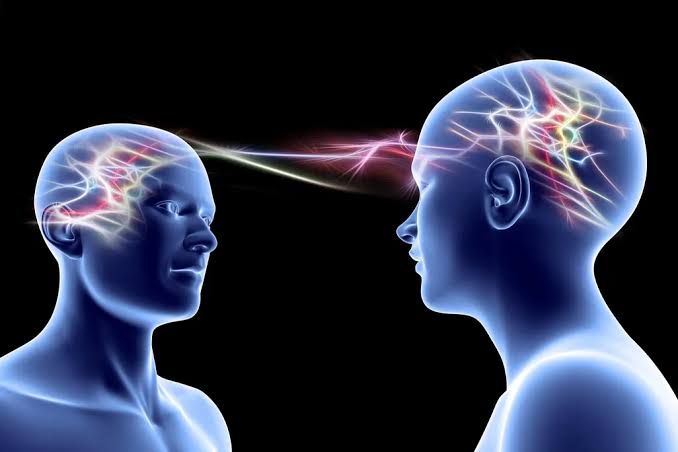
Think of telepathy like this. There’s two minds—one acting as a sender the other a the receiver. One mind sends a thought, image, emotion, sensation, or intention, and the other mind receives it. This mind-to-mind transmission can either (1) enable the sender and the receiver to passively communicate mental information, or it can enable (2) the sender to actively control or influence the receiver’s mind and body. It really all depends on what exactly is being transmistted.
For example, the transmission of a mental image of the receiver carrying out some behavior, might telepathically influence them to actually carry it out. Meanwhile, with a simple mental image of a dog, would just telepathically communicate that image, and the receiver may imagine that dog—or think of their own dog. The same goes for the sender’s transmission of an intense emotion, rather than the receiver merely perceiving it, it may actually end up influencing their mood.
So, unlike most people assume, telepathy isn’t just about passively communicating thoughts, feelings, and sensations between minds. There’s also a much stranger type of telepathy, which involves actively controlling or influencing another being’s mind (thoughts and feelings) and body (behavior and physiology) — simply by sending telepathic transmissions! This type of telepathic control or influence can be seen (albeit somewhat exaggerated) in Star Wars, with the famous, “Jedi Mind Trick.”

The Star Wars “Jedi Mind Trick” is an idealized science-fiction example of telepathic control or influence.
All of this means there’s actually two very distinct types of telepathy. I’ve coined these similar-sounding name pairings to distinguish between them:
•
Telepathic Communication — The ability to passively communicate mental information between sender and receiver—including thoughts, feelings, and sensations.
•
Telepathic Control — The ability for the sender to transmit mental images, feelings, and intentions that actively control or influence the receiver’s mind and body—whether their thoughts and feelings (mind), or their behavior and physiology (body).
You might now be wondering—why are both of these telepathy? Well, because both occur between a sender and receiver—and by the sender simply thinking, imagining, sensing, or feeling something, and the receiver either perceiving it, or being affected by it. In short because they both occur by mind-to-mind transmissions.
But, how can we say this phenomenon is truly something “psychic,” and not something explained by normal or even sneaky ways of communication and causal influence between beings? Well, for this to count as genuine telepathy, not “fraudulent” or just “normal stuff going on” — we need to emphasize that it must occur without normal means of communication or causal influence between beings. This means no spoken words, body language, facial expressions, or any other cues—and no touching! So, if some kind of communication or information transfer between minds, and control or influence of another’s mind and body, is achieved without these “normal” means, but by some mysterious process that we don’t quite yet understand—then we have ourselves a case of telepathy!
In summary, we might define telepathy like this:

Telepathy is the ability for two or more minds — some acting as receivers, others as senders — to transmit thoughts, emotions, and sensations to one another —without normal means of communication or causal influence between beings. These apparent “mind-to-mind transmissions” can either (1) passively communicate mental information between minds (”telepathic communication”), or (2) actively control or influence another mind and body (”telepathic control”). What type occurs all depends on the kind of telepathic transmission.
Types of Telepathy
This section will give us a taxonomy which we can use to refer to the different types of telepathy that pop up across everyday anecdotes and controlled scientific experiments. It’s easier when everyone speaks the same language, so do your best to remember and share the terms. As always, I’ve made it easier for you by naming some of them with similar-sounding words.
 Three Types by State of Consciousness
These are three types of telepathy classified by the state of consciousness telepathy can occur in.
•
 Waking Telepathy — Telepathy occurring during normal waking state.
•
 Dream Telepathy — Telepathy occurring during dream state.
 Daughter Dreams of Father’s Horse Accident
•
 Hypnosis Telepathy — Telepathy occurring during hypnotic trance.
 Two Types by Function
These are two types of telepathy classified by function or what telepathy does. You already got to see this in the definition section. With the fascinating insight that telepathy either (1) passively communicates information between minds (”telepathic communication”), or (2) actively controls or influences of another’s mind and body (”telepathic control”).
Let’s dive into each by giving a basic definition, their names throughout history, their sub-types, and examples of each from everyday anecdotes.
1. Telepathic Communication 

This type of telepathy is the ability to passively communicate, exchange, or transmit mental information or impressions between two or more minds—from sensations, thoughts, to emotions. The focus here is on the passive communication of information, as opposed to active control or influence.
Most people, even some psychical researchers and parapsychologists, often define telepathy focusing only on this type, often defining it in terms of “communication,” “information” or “perception”:
“The communication of impressions of any kind from one mind to another, independently of the recognized channels of sense.” — Fredric W. H. Myers (Founder of the Society for Psychical Research, originally coined the term “Telepathy,” see “Encyclopedia of Parapsychology & Psychical Research,” p. 431)
“Telepathy: Mental communication between living organisms, one transmitting information and one receiving information (referred to as the sender and the recipient).” — V. P. Zinchenko, A.N. Leontiev, B. F. Lomov, and A.R. Luria (Soviet Scientists & Parapsychologists; “Parapsychology: Fiction or Reality,” p. 3)
“Telepathy . . this is the transfer of information (not abstract thoughts, but rather ideas) directly from person to person, from the sender (inductor) to the receiver (percipient).” — Zdnenk Redjak (Founder of Psychotronics; “Psychotronics,” 1976)
“Telepathy . . perception of the thought or feeling of another without the aid of the known sensory processes.” — J. B. Rhine (Founder of Parapsychology; “Extrasensory Perception,” p. 3)
But, some psychical researchers and parapsychologists have actually made the distinction between this type and the other, and come up with a specific name for this type of telepathy. Here’s the names I found for it so far, and the names I’ve given to classify it.
•
Telepathic Communication — A term coined by me. It emphasizes “communication” from the standard meaning in information theory, “the exchange or transmission of information between two points” (Dr. Satyajit Kar). It also forms an alliterative pair with the opposite functional type I coined, “Telepathic Control.”
•
Telepathic Information — A term coined by me. It emphasizes the passive exchange of information. It also forms an alliterative pair with the opposite functional type I coined, “Telepathic Influence.”
•
Telepathic Cognition — A term coined by philosopher C. D Broad, to differentiate these same 2 types of telepathy. For him, this term and type emphasized the “cognizing or being cognized,” of “one embodied mind by another.” In other words, minds perceiving or becoming aware of each other. This differs from his “Telepathic Interaction,” which emphasizes embodied minds affecting each other causally (Broad, 1935, p. 419). He’s making the same distinction I did, just using different words & emphasis.
There’s many types of impressions that can be communicated or transmitted in this telepathy. Let’s take a look at each, with examples from spontaneous cases or anecdotal reports.
•
Thoughts◦
 Mental Pictures (Visual Thoughts)
 Man Sees Mental Image of Eggs Basket Mother-In-Law Made For Him
◦
Inner Voice (Verbal Thoughts) Friend Thinks of Same Word Friend Was Thinking for their New Invention
•
Sensations
◦
 External World Sensations (sights, sounds, tastes, smells, tactile)
◦
 Internal Bodily Sensations (pain, pleasure, body temp)
 Wife Experiences Pain of Injury of Husband’s Injury
 Cousin Experiences ‘Cold’ Feeling of Dying At Exact Time Her Cousin Dies
•
 Emotions
This type of telepathy also mostly occurs at a conscious level, meaning the receiver’s mind is directly aware of transmitted impressions, even if they don’t exactly know where they’re coming from, or even if they think they’re coming from their own mind. This is opposed to the other type, focuses on active control or influence, which occurs at a much more subconscious level, and the receiver’s mind is often not aware of any actual transmissions, they’re just subconsciously influenced or controlled.
But, as we’ve seen, this is still a limited understanding of what telepathy is, or what it does. Because it doesn’t just passively communicate information, it can also actively control or influence. That’s why I’ve coined another type of telepathy, focused on exactly that….
2. Telepathic Control
This type of telepathy is the ability to transmit mental images, feelings, and intentions that control or influence another’s mind and body—from their behavior, physiology, to their state of mind. The focus here is active influence or control, as opposed to passive communication of information.
Not many psychical researchers and parapsychologists have classified this type of telepathy. But some have, and it’s good to know the names throughout history that these researchers have given it, and the ones I have, so we can all speak the same language:
•
Telepathic Control — A term coined by me. It emphasizes active “control.” It also forms an alliterative pair with the opposite functional type I coined, “Telepathic Communication,” which emphasizes passice “communication.”
•
Telepathic Influence — A term coined by me. It emphasizes active “influence.” It also forms an alliterative pair with the opposite functional type I coined, “Telepathic Informaiton,” which emphasizes passive transmission of “information.”
•
Direct Mental Influence on Living Systems (DMILS) — A term coined by William Braud, American psychologist and parapsychologist, in his experiments. His focus was mental influence on biological systems, including their behavior (gerbils on exercise wheels, fish swimming in tanks), physiology (human electrical skin response) or consciousness (ability to concentrate, awareness of being stared at) (Braud, 2003). His experiments confirmed these effects, and meta-analyses support statistical significance of the results (Vasiliev, 1963, Foreword, p. xi).
•
Telepathic Interaction — A term coined by philosopher C. D Broad, to differentiate these same 2 types of telepathy. This term and type emphasizes the “causal influence of one embodied mind on another.” He also used words like “affecting causally or being affected causally,” and “influencing.” This differs from his other term & type, “Telepathic Cognition,” which emphasizes embodied minds merely becoming aware of each other (Broad, 1935, p. 419). Again, he made the same distinction I did, just used different words & emphasis.
•
Mental Influence — A term used by occult writers like William Walker Atkinson, such as in his book, “Practical Mental Influence” (this is the same dude that anonymously wrote “The Kybalion,” which many of you read).
There’s different types of telepathic influence or control, so far, I think we can classify at least these three:
•
Consciousness or State of Mind — Influence the mind state of another organism, whether their mood, ability to concentrate or focus, going from sleeping to waking or vice versa, and more. These transmissions are often conscious.•
 Behavior — Influence the behavior of another organism by transmitting mental images and feelings of them carrying out these behaviors. This influence can be conscious and subconscious. It can be conscious if the images or feelings appear in the receiver’s mind before they carry out the behavior. It might be more subconcious if the receiver simply has an impulse to carry out that behavior.
 •

 Physiology — Influence the physiology of another organism, from their blood-cell count, blood pressure, electrical skin response, and more. This influence is the entirely subconscious.
 As we can see from these types of telepathic control or influence, this telepathy can occur at both conscious and subconscious levels. At a subconscious level, the receiver isn’t aware of any telepathic transmissions, but they are still influenced by them — which often occurs only for physiological influence. At a conscious level, the receiver is aware of the telepathic transmission, either the same exact one sent, or merely something similar — which often occurs for influence on behavior & state of mind.
physiological influence. At a conscious level, the receiver is aware of the telepathic transmission, either the same exact one sent, or merely something similar — which often occurs for influence on behavior & state of mind.One of the best examples of this ability is actually “Distant Healing” (also called Mental, Psychic, Intention, Nonlocal, and Absent Healing) (Rubik and Pavek, 1995), where healing is attempted without contact, and at a great distance, using soley visualization and intention based techniques (CIA Archives, [Vinchenko, V. P., Et al.], 1973). Some examples of this are “long-distance Reiki” and “intercessory prayer,” both of which have scientific experiments and statistics that confirms their effects—including aiding in pain relief, improve psychological well-being, reducing chronic pain, reducing blood-pressure, and more. Although this is often often mistakenly seen as something separate from telepathy, often seen as “energy healing,” it’s actually a specific type of telepathic influence on a receiver’s body and mind.
 Two Types by Sameness or Similarity of Transmission
When you have a telepathic experience, you may receive exactly the same transmission the sender was thinking, imagining, feeling, or sensing. Like when you begin humming the same song as your friend without you mentioning it.
But, sometimes, you only become aware of something that’s merely similar to what the sender had in their mind, but not exactly the same as it. For example, if you had a mental image of a snicker’s bar, and the sender started thinking and craving chocolate.
This means there’s two more distinct types telepathy, which are classified by the resemblance between the impression that what was telepathically sent, and what was actually telepathically received. These impressions can either be (1) the exact same or (2) merely similar. So, to make it easier to remember, I’ve coined two easy terms for this:
•
Same Telepathy
•
Similar Telepathy
I’m not alone in notincing this distinction either. This is a distinction that early pioneers in psychical research and founding members of the London Society for Psychical Research—Edmund Gurney, Frederic Myers, and Frank Podmore—made in their book which is now a classic in the field, “Phantasms of the Living: Volume I.” They called it the distinction between “direct transference” and “indirect transference.” Although, for clarity, and a side of ego, I’ll be sticking with my terms.
As always, let’s briefly define each type, show the names researchers have given them, and real-life example from spontaneous reports of telepathy.
1. Same or Direct Telepathy 🟰
In this type, the receiver becomes aware of the exact same mental impression the sender had in their mind, not merely something similar. For example, if sender has an inner voice thought (“I miss my dog”), or a mental picture (an image of their dog), and the receiver hears those same words inside their head, or sees that exact same mental image. It is the telepathy where you know exactly what someone else is thinking, feeling, or sensing.
Here’s the names researchers have given this type:
•
Same Telepathy — A term coined by me, and described above.
•
Direct Transference — A term coined by pioneering psychical researchers and founding members of the London Society for Psychical Research—Edmund Gurney, Frederic Myers, and Frank Podmore, in their cult-classic book, “Phantasms of the Living: Volume I.” They described as the telepathic situation where “what enters the [receiver’s] mind is the exact reproduction of the [sender’s] thought at the moment” (p. 231). They noticed that many cases of “spontaneous telepathy” and “experimental telepathy” have this in common.
•
Telepathic Prehension — A term coined by philosopher C. D. Broad, in his paper, “Normal Cognition, Clairvoyance, and Telepathy.” He described it as the telepathic situation where, “N’s experience of sensing a certain sensum or of imaging a certain mental image were also an experience of M’s. Then M would be sensing or imaging the very same sensum or image which N is sensing or imaging” (p. 423).
Some spontaneous cases or anecdotal examples:

 Boss Knows the Exact Question An Assistant Will Ask Friend Thinks of Same Word Friend Was Thinking for their New Invention
 Daughter Thinks Mom’s Exact Thought
2. Similar or Indirect Telepathy 
In this type, the receiver becomes aware of a similar impression that the sender had in their mind, but not exactly the same as it.
Here’s the names researchers for similar telepathy:
•
Similar Telepathy — A term coined by me, and described above.
•
Indirect Transference — A term implied by pioneering psychical researchers and founding members of the London Society for Psychical Research—Edmund Gurney, Frederic Myers, and Frank Podmore, in their cult-classic book, “Phantasms of the Living: Volume I.” They described it as the telepathic situation where “what what the one party perceived was not that on which the mind of the other party had been concentrated” (p. 111).
•
Telepathic Interaction — A term used by philosopher C. D. Broad, in his paper, “Normal Cognition, Clairvoyance, and Telepathy.” He described it as the telepathic experience of “a sensation with a similar sensum, or of an imagination with a similar image, or of a bodily feeling with a similar quality and feeling-tone” (p. 424). This is the same as his term for telepathic causation because he didn’t really distinguish them as two seperate types. Instead, he thought experiencing “similar” tranmissions just shows how one mind can causally affect another mind.
Some spontaneous cases or anecdotal examples:
Wife Experiences Smell of Roses 
 Which Husband Was Thinking About
Which Husband Was Thinking About One question I have for similar telepathy, is this similar mental impression that the receiver becomes aware caused by the subconscious mind (the first to receive psychic impressions) giving a mental impression that draws from memory, which is stimilar to what was actually telepathically received? Does this count as “noise” within the information channel, as static or interference from the brain’s memory, that disrupts the original transmission—rendering it as something else?