



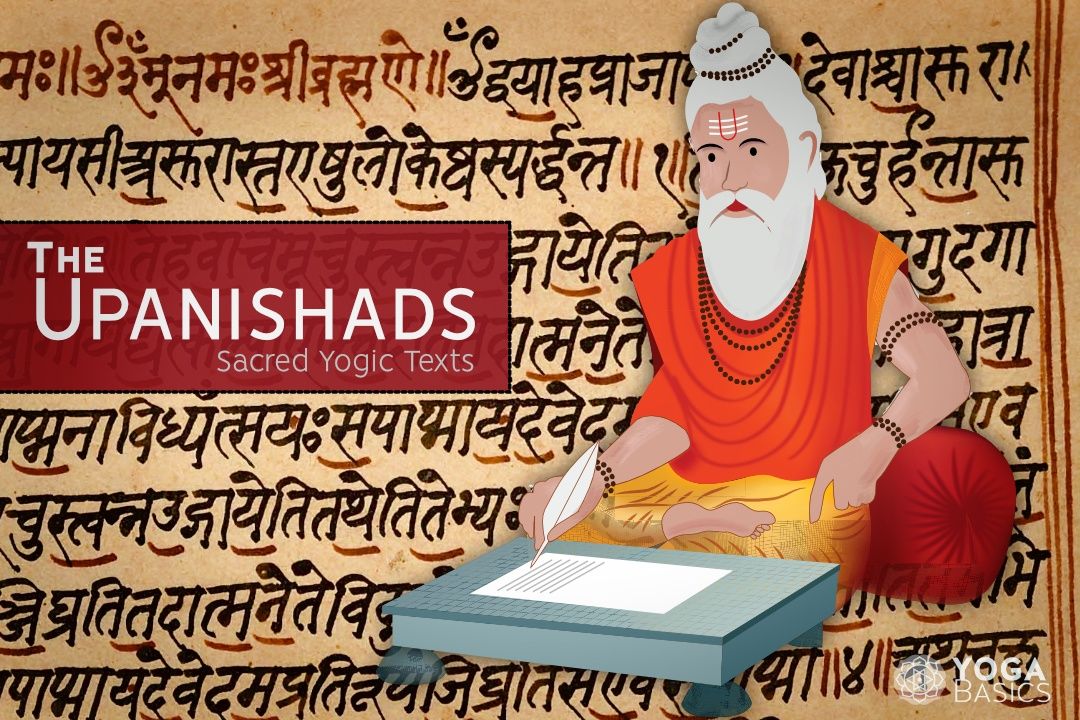
Everything the ancient Indian philosophers and mystics taught, from master to teacher, for hundreds of years — was written down into poems, stories, philosophical dialogues, and mystical experience reports, of the ancient texts they called, the “Upanishads.” Which literally translates to, “to sit down near,” and signifies students sitting down near the feet of a spiritual teacher or Guru, and receiving their mystical and philosophical knowledge.
•
Its name may also signify how the Upanishads sit at the very end of “the Vedas.” The Vedas literally means, “knowledge” or “wisdom,” and it’s a large collection of ancient Sansrkit hyms, prayers, ritual procedures, philosophical and mystical texts, composed around 3,500 to 2,500 years ago (1500-500 BCE) — which lies at the heart of Hinduism. In fact, the Vedas are so important to the religion, that Hinduism itself is sometimes called, “the religion of the Vedas” (vaidika dharma) (Sushanta, 2008, p. 43).

“Access to the Vedas is the greatest privilege this century may claim over all previous centuries.” — Robert Oppenheimer (American Theoretical Physicist) (The Father of the Atomic Bomb)
There’s four chronological layers to the Vedas, which I think are very symbolic, and show the dramatic change in the Hindu religion that took place over 1,000 years. From the religious poetry and priest rituals for the polytheistic nature gods in the early parts of the Vedas — to the philosophical and mystical musings about the monotheistic and panentheistic God (Brahman), in the final parts of the Vedas. I think you’ll notice this gradual religious change too in the table below:
Textual Layer of the Vedas | Time Period | Authors | Contents |
3,500 to 2,900 years ago (1500 to 900 BCE). | Religious poets. | Mantras, hymns, prayers, and ritual blessings to the polytheistic nature gods. | |
2,900 to 2,700 years ago (900 to 700 BCE). | Ritualistic priests and religious poets. | Meaning of mantras, myths and legends, ritual instructions, and some sciences used for rituals (mathematics, geometry, astronomy). | |
2,700 to 2,600 years ago (700 to 600 BCE). | Religious priests and early forest-dwelling hermits. | Symbolic meanings of the ritual sacrifices, shifting away from literal sacrifices and to more abstract spiritual concepts (prana or cosmic energy) and internal practices (asceticism, meditation, breathwork). | |
2,600 to 2,300 years ago (600 to 300 BCE). | Forest-dwelling mystics and philosophers. | Deep philosophical speculations and mystical experiences on the self (Atman) and the monotheistic-panentheistic God (Brahman) — in the form of poems, stories, and dialogues. |
This fascinating chronology is why the Upanishads are called “Vedanta,” literally meaning “the end of the Vedas.” It’s the culmination of the Vedic religion, into its final mystical-philosophical form! It is also, as the Shvetashvatara Upanishad put it more than 2,500 years ago:
“The supreme mystery in the Veda’s End (Vedanta)…” – Shvetashvatara Upanishad 6.22. (500-400 BCE) (Hume, 1921. p. 394….)
I think this pretty much gives you a big enough picture of the Upanishads, from their teachings, to their history. So, let’s wrap things up.
I’ve quoted only some of these Upanishads in the other pages, as there’s a whopping 108 of them, and I didn’t get around to reading them all. But, I still think I distilled the essence of their teachings. Culturally, I think they’re also a must-read, and pretty fascinating if you’ve ever come across ideas of “the observer” or “non-duality,” in new age circles, as they trace their roots back to these very texts. Many intellectuals, including all the famous quantum physicists like Erwin Schrödinger, Neihls Bohr, and Robert Oppenheimer, also spoke of them highly.
“I go into the Upanishads to ask questions.” — Niels Bohr (Danish Physicist) (Developed A Model of Atom) (Prothero, 2010, p. 144.)
“The ancient wisdom of the Upanishads.” — Erwin Schrödinger (Austrian physiticsts) (Developed the wave-function equation in quantum physics & the “Schrödinger's cat” thought-experiment) (Schrödinger, 2008, p. 31.)