



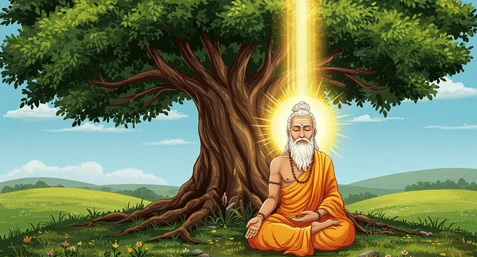
This article isn’t done, still in the works…
1.
 Knowledge (“vidya”) — The learned knowledge of self and ultimate reality and the steps to attain their union, which one acquires when reading the Upanishads themselves, or being personally taught by a spiritual teacher or guru. For the student, there were often certain pre-qualifications before being taught — like having a calm mind and behavior, and a loving devotion (“bhakti”) to God and to one’s spiritual teacher.
2.

 Renunciation (“Sanyasa”) or
  Asceticism (“Tapas”) — Meaning ___, includes things like self-isolation, fasting, elibacy, possessions, and basically all the things that ascetic monks or hermits typically do (Vedanta Kesari, 1961). Most scholars call this step. but I think the term “reuniciation” (“sanyasa”) does a better job of communicating the meaning of this step.
3.
 Meditation (“Dhyana”) — Meditative contemplation, and the techniques associated with it, such as breath-control (”pranayama”), one pointed concentration (”dharana”), and repating the mantra “OM” (”japa”). This is the final step, after one knows of the self and brahman, undergoes mental or physical discipline (or both), then you can sit down, concentrate, control the breath, withdraw the senses, concentrate your mind a mantra, until achieving the absorption (”samadhi”) or union (”sayujya,” “yoga”).
“Brahma is!’ says he who knows the Brahma-knowledge. This is the door to Brahma!’ says he who becomes free of evil by austerity (tapas) [or renunciation (sanyasa)]. ‘Om is the greatness of Brahma!' says he who, completely absorbed, meditates on it. Therefore, by knowledge (vidya), by austerity (tapas) [or “renunciation” (sanyasa)], and by meditation (dhyana), Brahma is apprehended.” – Maitri Upanishad 4.4. (Hume, 1921. p. 421.) (Muller, 1884, p. 301.)
“By truth can this self be grasped— by austerity [or renunciation], by right knowledge, and by a perpetually chaste life.” – Mundaka Upanishad 3.1.5. (800-400 BCE) (Olivelle, 1996, p. 449.)
But, what does each one actually mean, or look like, in practice? Let’s go over each individually, incase you want to try the Indian mystical method yourself.
#1. Knowledge (“Vidya”) — A Student With Proper Qualifications Learns The Knowledge of Self & Brahman By Spiritual Teacher or Guru
This first step is quite simple — it is basically to have someone teach you. In short, to learn the knowledge of not just the soul (atman) and the ultimate reality (brahman), but the steps to attain their union. You can acquire this by reading the Upanishads themselves, or by being personally taught by a spiritual teacher or guru. If you count me as your teacher, this is essentially what you’re doing right now — so you can check that off your list.
“To understand it he must go, firewood in hand, to a teacher well versed in the Vedas, and focused on brahman. To that student of tranquil mind and calm disposition, who had come to him in the right manner, that learned man faithfully imparted, The knowledge of brahman.” — Mundaka Upanishad (1.2.12-13.) (Olivelle, 1996, p. 441-442.)
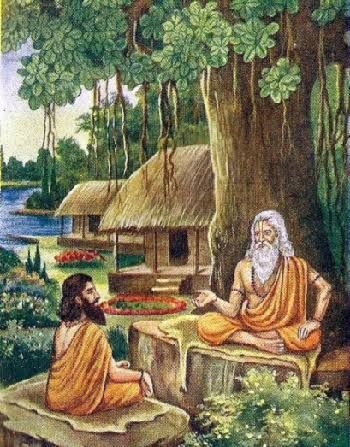
Although, I have to tell you that the Upanishads were more strict on this than someone like me might be today. They required utmost dedication of the student to their teacher, or even for the student to be the teacher’s son or daughter. Plus, not everyone who wanted to learn was taught. The student or pupil often had to have certain characteristics — like calm mind and behavior, a deep loving devotion (“bhakti”) to God, and even to one’s spiritual teacher. But, don’t worry, I’m not asking that of you. But, you can still get that if you travel to India and find a traditional guru.
These knowledge prequalifications were often proclaimed at the end a chapter within an Upanishad, or the end of an entire Upanishad text. As if to say, “By the way, don’t tell this to just anyone.” Here’s some examples:
“This supreme secret was proclaimed during a former age in the Vedanta. One should never disclose it to a person who is not of a tranquil disposition, or who is not one's son or pupil. Only in a man who has the deepest loving devotion [“bhakti”] for God, and who shows the same loving devotion toward his teacher as toward God.” – Shvetashvatara Upanishad 6.22-23. (Olivelle, 1996, p. 433.) (500-400 BCE)
“This profoundest mystery one should not mention to any who is not a son, or who is not a pupil, or who is not tranquil. However, to one who is devoted to none other than to his teacher, or to one who is supplied with all the qualifications, one may give it.” – Maitri Upanishad 6.29. (Hume, 1921. p. 442.) (400-200 BCE)
In summary, here’s what’s needed in the first step of achieving mystical union, according to the Indian mystics:
Prequalifications or Prerequisites:
•
A calm mind and behavior.
•
But, once one has the necessary qualifications and knowledge, whats next?
Well, the Indian mystics thought that in order to sit long hours in meditation, it was necessary to renounce everything, so that their sole goal in life becomes meditating and attaining the mystical union. I don’t think this is necessary, so if that scares you then you can skip the next section #2, and go straight to the meditative techniques (section #3).
But, if you’re curious and want to see the full picture, read along to see how the Indian mystics themselves describe the process of renunciation, and practical techniques they devised to gradually transition to it without completely throwing your life away…
“Having well ascertained the object of the knowledge of the Vedanta [step 1], the ones who make an effort have their being purified by the yoga of renunciation [step 2]...” — Mundaka Upanishad 3.2.6. (700-300 BCE) (Bruno’s literal translation) (upanishads.org.in.) (wisdomlib.) (Muller, 1884, p. 41.) (Olivelle, 1996, p. 452.)
After all, remember that the ancient mystics were using Sanskrit words to write — which had a specific meaning thousands of years ago in their ancient context and culture. The problem is, when we read their texts translated to English, sometimes the words don’t have a direct 1-to-1 translation — instead, for complex words (unlike for simple words like “water”), we’re mostly reading words the translator picked as a “close enough” but not an exact English equivalent to the original Sanskrit word.
This loses some of the ancient meaning of the original Sanskrit word the ancients used, by hiding it behind the different modern meaning of the English word the translator used. So, in order to avoid this messy loss of meaning by translation, we’ll explore this step by analyzing the original Sanskrit words and their ancient meaning, and their chosen English translation.
As ”Tapas” — “Inner Heat” Created by Harsh or Simple Living, Which Purifies the Individual
One of the main Sanskrit word the ancient mystics used for this step was “tapas” — coming from the root word “tap” (to burn or to heat) — so it literally means something like “to burn away” or “to heat up.” Now, what on earth could this actually mean in this context of a step to mystical union?
Well, the word was originally used or associeted with the god of fire (”Agni”) in ancient Vedic rituals. But, overtime, as Vedic religion shifted away from literal rituals for the nature gods, and interpreted them more as symbols for inner spiritual ideas and practices. It came to symbolize an “inner fire” generated by harsh or simple living or ascetic practices (like fasting, having no posessions, being homeless, etc.) — which was though to burn away the impurities of the individual (Britannica, “Tapas.”) (Smith, 2008, p. 144.).
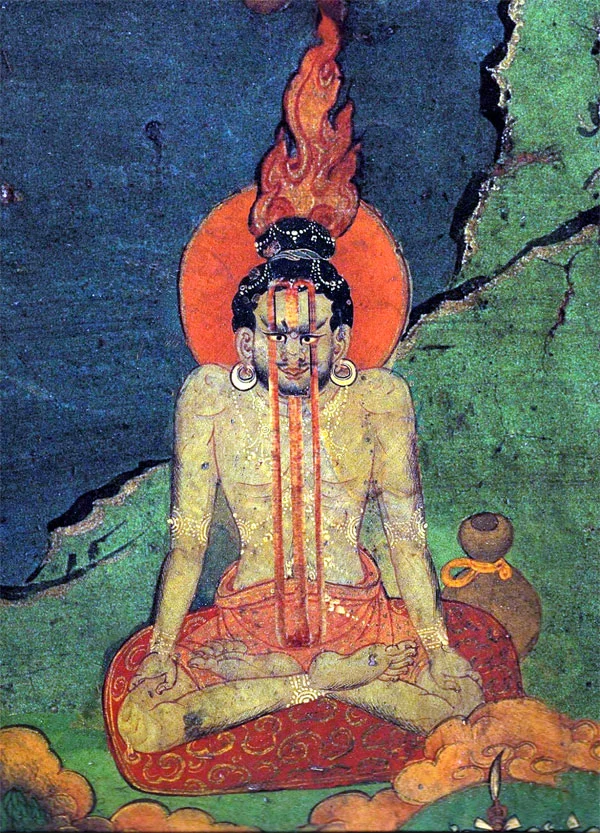
“By austerity, impurities of body and senses are destroyed…” – Yoga Sutras of Patanjali 2.43. (Yoga Sutra Translations.)
Potentially, this may have been seen as making the mystic ready for deeper spiritual practices like meditaiton, where one needed to rid themselves of all things human, emptying themselves out or becoming completely pure, until only the essence of God within them is left.
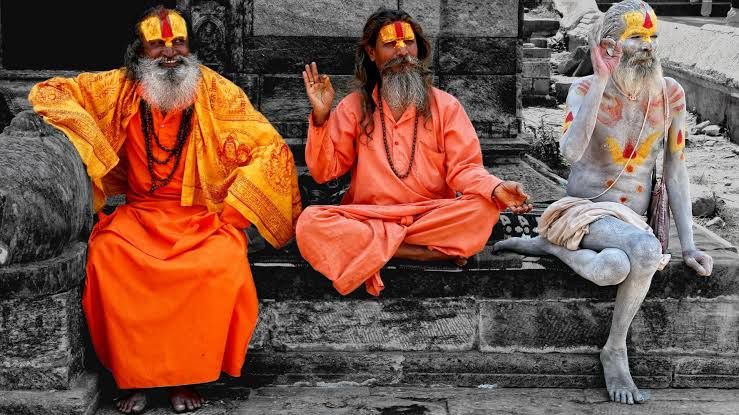
This word is also the reason why ascetic monks robes and face paint is often dyed red or orange — this color represent the inner fire of spiritual purification.
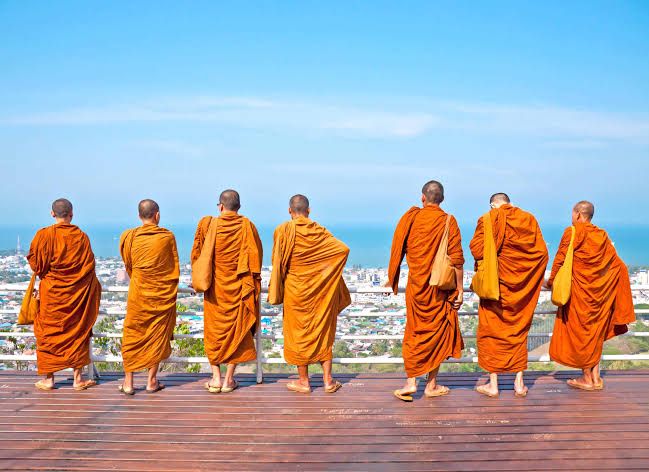
Now lets see how much the English translation f*cked this up. The much less accurate English word this word usually picked, is either “asceticism” or “austerity.” I personally had never heard of these words, so lets dive into what they mean in our modern day context and culture.
“By knowledge (vidya), by austerity (tapas), and by meditation (dhyana), Brahma is apprehended.” – Maitri Upanishad 4.4. (Hume, 1921. p. 421.) (Muller, 1884, p. 301.)
“Austerity” often means extremely simple or plain living, with only the bare minimum necessities, and nothing extra (Cambridge Dictionary, 2026.). It’s basically human life reduced to its bare bones. The word comes from the ancient Greek, “austērós,” originally meaning dry, harsh, or sour to the taste; which makes sense, as austere life is clearly, quite harsh and distasteful.
“Asceticism,” on the other hand has multiple meanings. It means either (a) the practice of simple living often avoiding physical pleasures for religious reasons (Cambridge Dictionary, 2026.); (b) the practice of severe self-denial or “abstinence from self-induldence” for spiritual discipline; or (c) the practice of self-mortification like depriving onself and causing discomfort to oneself for spiritual discipline (Etymonline) (Merriam-Webster Dictionary, 2026.). The word actually comes from the ancient Greek “áskēsis,” meaning “to exercise, “to train,” or “to practice” (Britannica, 2026, “asceticism.”).
In summary, a combined rendering of the English words along with the original Sanskrit word — might make this step mean something like this:
1. The practice of simple living, with only the most necessary things and nothing extra, order to purify oneself for deeper spiritual reasons.
2. The practice of self-control or abstinence from self-indulgence, in order to purify oneself for deeper spiritual reasons.
3. The practice of self-mortification or depriving and causing discomfort to onself, in order to purify oneself for spiritual reasons.
All are often symbolized by an “inner fire” created by these practices.
“inner fire” created by these practices.But, this isn’t the only meaning the ancient mystics may have had for this step.
As ”Sanyāsa” — “Completely Putting Down” or Giving Up Worldy & Societal Life, to Cultivate Detachment & Focus Only on Spiritual Goals
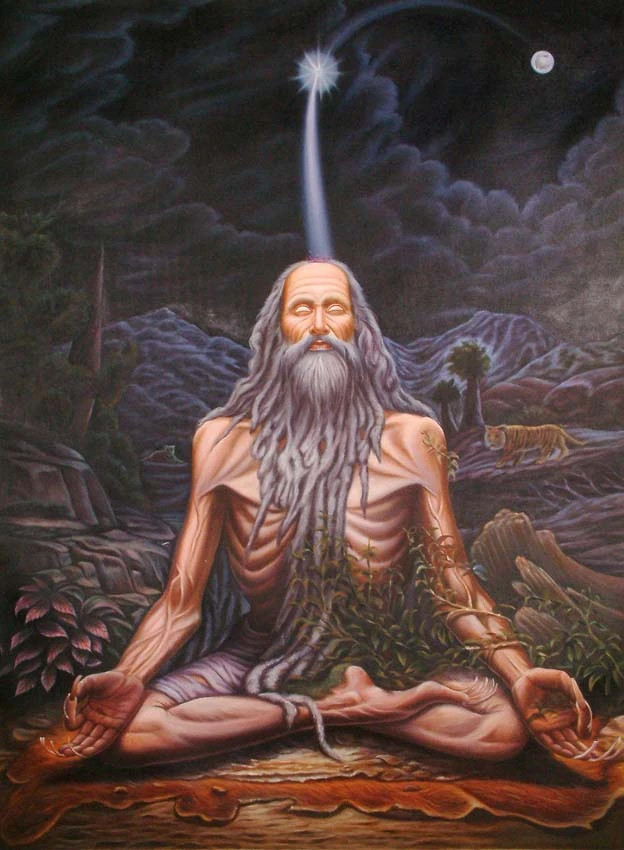
The other Sansrkit word the ancient Indian mystics used for this step is “Sanyāsa” — coming from the root words “āsa” (to put), “ni” (down), and “sam” (completely) — so it literally means, “to put down completely.” The English equivalent is “renunciation” — which means voluntarily giving up, abandoning, or rejecting something. In this context though, it means “giving up,” “abandoning,” or “rejecting” worldy and societal life.
•
What does this actually entail? Well, it involves gradually giving up — most possessions (only having a begging bowl, water cup, walking stick, clothing rags, etc.; or nothing), conventional hairstyle (having outgrown hair or shaved head), a home (wandering homeless, living in the forest), certain foods and large amounts of food (eating only plants you gather or food you beg for), other human beings including family & friends (living completely alone), romantic partners (not talking, looking, or even thinking of the sex you’re attracted to), talking or speech (remaining silent), learning and teaching (all besides OM mantra), even most spiritual practices (all besides meditation).
“Having said farewell to all living beings, having gone to the forest, having renounced all sensuous objects, let man perceive the Self from his own body...” – Maitri Upanishad (6.8) (500-200 BCE) (Muller, 1884, pp. 311-312.)
You’re probably wondering, why on earth would anyone do this? How could this ever help anyone attain the state of mystical union? On the surface, it seems like this would just put you in an incredible amount of unecessary pain and suffering. And well, in part, that’s right. But, I think the main reason all ties back to what I believe are the two goals or purposes of renunciation.
 The Goal or Purpose of Renunciation
 #1. The Goal of Detachment & Indifference to Everything — ”Vairagya”
The first goal, in my opinion, is to attain an internal state of complete detachment or indifference to everything — from the senses, thoughts, emotions, and even bodily identity (the sense that “I am this body”).
“When the mind loses all desires for objects seen or described in scriptures, it acquires a state of utter desirelessness which is called detachment.” – Yoga Sutras of Patanjali 1.15. (Chapter 1, Verse 15.) (composed 200 BCE - 400 CE) (Yoga Sutra Translations, “HA”.)
“He shall undoubtedly attain liberation whose mind and senses have ceased to act; who is without desires . . who is beyond the pairs of opposites . . who is free from the conceptions of ‘I’ and ‘mine’; who has no cares . . he achieves detachment…” – Nāradaparivrājaka Upanishad (Chapter 3, 149.) (composed 1150 CE) (Olivelle, 1992, p. 180.)
“Enduring the pairs of opposites, he is affected neither by cold nor by heat, neither by pleasure nor by pain, neither by sleep nor by honor and dishonor. He is freed from the six waves of existence. He gives up slander, egotism, jealousy, pride, deceit, envy, indignation, desire, hate, pleasure, pain, lust, anger, greed, delusion, and the like, and he regards his body as a corpse.” – Nāradaparivrājaka Upanishad (Chapter 3, 153-156.) (composed 1150 CE) (Olivelle, 1992, pp. 183-184.)
Detachment and indifference to the five senses, for example, basically means having no reaction to anything seen, heard, touched, tasted, or smelled. The texts said that it is as if the mystic becomes, “tongueless,” “blind,” “deaf.” Or as if they’re literally asleep while awake. When eating “he who does not notice even as he eats that one thing is tasty and another is not.” When seeing, he “does not look afar but fixes his gaze on the ground just six feet in front of him.” (Nāradaparivrājaka Upanishad Chapter 3 and 5; Olivelle, 1992, p. 179, 200.)
“When a man is attached to his senses, undoubtedly he incurs guilt. But once he brings them under control, he will attain perfection . . When a person feels neither elation nor revulsion at what he hears, touches, eats, sees, or smells, he should be regarded as a man who has conquered his senses.” – Nāradaparivrājaka Upanishad (Chapter 3, 143.) (1150 CE) (Olivelle, 1992, p. 177.)
“That man may be considered to have really subdued his [sense] organs, who on hearing and touching and seeing, on tasting and smelling (anything) neither rejoices nor repines.” – Manusmritti (Chapter 2, Verse 98.) (”The Laws of Manu,” George Bühler, Translator.)
Most people who write about “renunciation” say this complete “detachment” and “indifference” is just one of the things renunciates do — like the actual acts of renunciation themselves. But, I think it’s very different. In fact, all the acts of renunciation are merely a means to this end. Its precisely because the mystic lives having renounced posessions, hairstyle, food, a home, other beings, romantic partners, speaking, and so on — that they gradually become detached and indifferent to everything — the senses, emotions, thoughts, and bodily identity. In short, the giving up of external, physical, wordly and societal life, is what gets you to this internal state of complete detachment to it.
Or at least, that’s just my intuition about this peculiar spiritual practice. But, this isn’t the entire reason for doing it.
 #2. The Goal of Having A Singular Focus on Attaining Mystical Union Through Medition
The second goal or reason (in my opinion), is probably the most important, and it is to have singular focus on the goal of mystical union with God. When everything else is renounced, the mystics single pursuit, their only desire, their sole goal, becomes attaining this mystical state. Their entire world is to sit everyday, meditate, repeat the “OM” mantra internally, and try to transcend the mind, and become one with God.
“He devotes himself completely to meditating on the pure Brahman. He is grounded in the Supreme Self…” – Jabala Upanishad 6 (300 BCE - 300 CE) (Olivelle, 1992, p. 144.)
“Indifferent to everything, firm of purpose, meditating (and) concentrating his mind on Brahman.” – Manusmritti (Chapter 6, Verses 43) (300 BCE - 200 CE) (”The Laws of Manu,” George Bühler, Translator.)
“Forsaking the worlds and the Vedas, the senses and the objects of sense, he who abides in the self alone attains the highest state . . Let him devote himself to meditating deeply on the Brahman-OM.” – Nāradaparivrājaka Upanishad (Chapter 4, & 7.) (Olivelle, 1992, p. 184, 2014.) (1150 CE)
That renunciation would help with this kind of makes sense when you think about it. Have you ever sat in meditation? Well, if you have you’ll notice that when you have everyday lie stuff to worry about, you will invevitably be distracted because you have other things on your mind, other life goals. Plus, you’re also affected by the senses — by your leg suddenly itching, getting hungry, or the AC being a bit too cold.
But, imagine if you renounced all worldly goals, and on top of that, you have a complete detachment and indifference to all senses and your bodily identity (goal #1). Well then, sitting silently in meditation, for hours, every single day, is probably a lot easier.
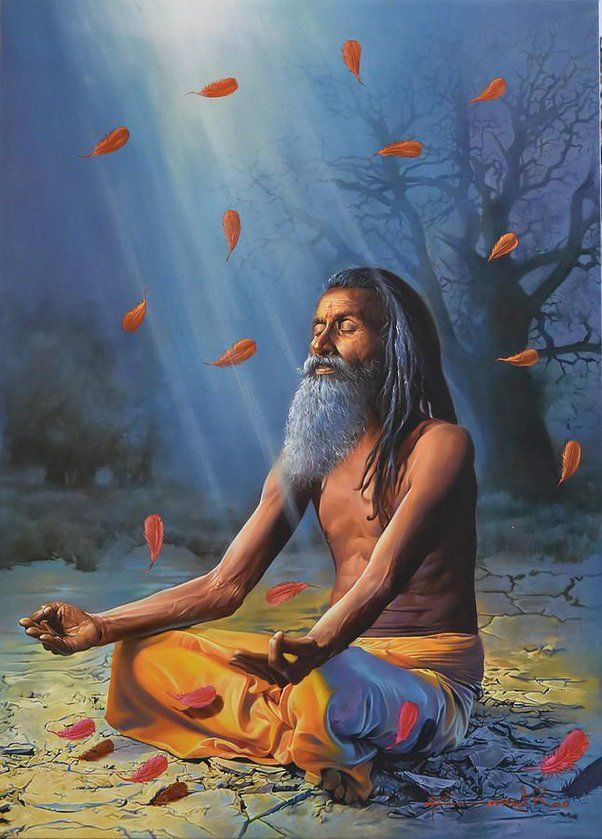
 A Full List of Examples of Renunciation or Asceticism
But, what does renunciation or asceticism actually entail? What are some real examples of this from the ancient Indian mystics themselves? Lets take a look.
Renunciation or Austerity | Explanation | Quote From Text |
Material possessions; few, or no possessions. | Those with few possessions might have a begging bowl (to collect food, or money), a water bowl, a small shovel (to dig for edible roots in forest), a staff (to walk), a small bag or sling (like a small net tied to a stick, or any small bag to carry things), a loincloth (a piece of cloth that covers the genitals), a waistband (a belt-like strap that holds the loincloth), and a robe (protects from cold, wind, heat; often dyed orange), and some shoes. The highest renouncers put all these down, and walk around completely naked, with nothing but their body. | “A pot, a drinking cup, a sling, a tripod, a pair of shoes, a patched garment against the cold, a loincloth, a water strainer, a bathing cloth, and an outer garment: an ascetic should avoid anything else other than these.” – Laghu-Samnyasa Upanishad (500-200 BCE) (Olivelle, 1992, p. 104.) |
Conventional hairstyle | A shaved head, or outgrown hair. The initial renouncers shave their head, and do it less and less as they become more detached, until they no longer shave. | • “A wanderer who wears discolored clothes, shaves his head.” – Jabala Upanishad 5 (300 BCE - 300 CE) (Olivelle, 1992, p. 144.)
• “Let him always wear (his hair in) braids, the hair on his body, his beard, and his nails (being unclipped).” – Manusmritti (Chapter 6, Verse 6) (200 BCE - 300 CE) (”The Laws of Manu,” George Bühler, Trans.) |
Home | Wandering homeless. | “At all times he lives resolutely without a home in deserted houses, at the foot of trees, in temples, on haystacks, in potter’s sheds, in sheds for fire sacrifices, in the southeastern quarter, on the sandy banks of rivers, in cellars, in glens, by waterfalls, in open fields, or in a forest.” – Nāradaparivrājaka Upanishad (Chapter 3, 153-156.) (1150 CE) (Olivelle, 1992, pp. 183-184.) |
Income | Begging for food or water — and often required to beg only for enough to survive. | “Merely to sustain his life, he begs food...” - Jabala Upanishad 6 (300 BCE - 300 CE) (Olivelle, 1992, p. 144.) |
Certain foods and large amount of food. | Eating mostly fruits and roots, since they’re vegetarian. They eat just enough to survive (food is seen as medicine), and only what they gather from the wilderness, or begging. They also can’t receive full meals from donors, and they may even fast on some days. | “Let him eat vegetables that grow on dry land or in water, flowers, roots, and fruits, the productions of pure trees, and oils extracted from forest-fruits. Let him avoid honey, flesh, and mushrooms growing on the ground.” – Manusmritti (Chapter 6, Verse 13-14) (200 BCE - 300 CE) (”The Laws of Manu,” George Bühler, Translator.) |
Family, friends, and native land. | Renounce all the people and places close to them, which they might have emotional attachments to. | “Like a thief released from jail, let him forsake his sons, close relatives, and his birthplace, and live far away.” – Nāradaparivrājaka Upanishad (Chapter 7, 201.) (1150 CE) (Olivelle, 1992, p. 214.) |
Most other human beings. | Some might stay in a pair, or groups. But the true renouncers wander completely alone. | • “Let him always wander alone, without any companion, in order to attain (final liberation), fully understanding that the solitary (man, who) neither forsakes nor is forsaken, gains his end . . [live] life in solitude . . with himself for his only companion.” – Manusmritti (Chapter 6, Verses 42, 44, 49) (300 BCE - 200 CE) (”The Laws of Manu,” George Bühler, Translator.)
• “One constitutes a true mendicant. Two, the scriptures say, form a pair. Three are called a village. Anything more make a city. Let him never form a city, or a village, or even a pair.” – Nāradaparivrājaka Upanishad (Chapter 3, 145.) (Olivelle, 1992, p. 179.) (1150 CE) |
Speech or talking | “...wholly silent…” – Manusmritti (Chapter 6, Verse 25.) (”The Laws of Manu,” George Bühler, Translator.) | |
Romantic partners, sexual desires. | They practice extreme chastity. They can’t talk to, look, or even think of the opposite or the same sex they’re attracted to. | “Let him neither converse with any woman, nor call to mind one he has previously seen. Let him avoid talking about women and not even look at a picture of one. An ascetic’s mind is inevitably perturbed if he behaves with women foolishly in these four ways. When his mind is perturbed he will perish.” – Nāradaparivrājaka Upanishad (Chapter 4, 157.) (1150 CE) (Olivelle, 1992, p. 185.) |
Learning and teaching | They can’t teach or learn anything besides what’s required for mystical union, like meditation, and the mantra “OM.” | “Let him neither study nor expound; let him not listen to anything else. He shall not pursue either a philosophy or even scriptures other than the syllable OM. Let him not teach numerous scriptural passages.” – Nāradaparivrājaka Upanishad (Chapter 5, 176.) (1150 CE)(Olivelle, 1992, p. 199.) |
Spiritual practices | They give up all other spiritual practices, from sacrifices, festivals, pilgrimages, and so on. Only renunciation and meditaiton, and mantras are practiced. | “Ascetics shall not perform divine worship, watch festivals, or undertake pilgrimages.” – Nāradaparivrājaka Upanishad (Chapter 5, 176.) (Olivelle, 1992, p. 199.) (1150 CE) |
 How Indian Mystics Became Renouncers or Ascetics Without Completely Throwing Their Life Away — The 4-Stage Life System (”Asrama”)
But, clearly, the level of comittment required by renunciation or asceticism isn’t sustainable for most people at the early stages of their life. Since we all have wordly and societal goals we want to accomplish — get a job, build a career, make money, get a life partner, buy a house, start a family, travel the world, fulfill our life’s purpose, and the list goes on. Furthermore, if a lot of people suddenly became renouncers, society would suffer negative consequences, since a large amount of people wouldn’t be contributing anything to their society.
The ancients thought of these big problems too. That’s why they created the “Asrama” — a four-stages of life system, which allows people to still have a worldy and social life required and desired by many early on in their life, and slowly transition to the life of a renouncer at the later stages of their life — but only after one has obtained their worldly goals and contributed to society.
I’ve created a simple table for these 4 stages of life, which simplifies and adapts them to 21st century culture — since the strict rules in the actual stages are a bit over the top (see Sharma, 1999. pp. 30-40.). FYI, this system supposes the span of human life is 100 years and divides this time into the stages (Sharma, 1999. p. 28.). It’s also recommended that one goes through the stages sequentially, although one could also jump around (like from the first to the third or fourth). The information from this table mostly came from chapters 2-6 of the Manusmriti (”Laws of Manu”).
Life Stage | The Original Sanrkit Term | Etymology of Sanskrit Term | Description | Recommended Age (Years Old) | Sign to Transition Out of Stage |
Student of Life | “Moving to Brahman” | A child and adolescent, growing up, gathering life experience and early studies. | 0-25 | After one has learned enough, from their studies, or life experience, to embark on a career or job, and a partner with which to start a family (if desired). | |
Job, House, or Family Holder | “Living in a home.” | An adolescent to middle aged individual who may pursue a carrer, build a family, obtains their worldy and societal goals — all to contribute to their society, and fulfill their life’s purpose. | 25-50 | “When a householder sees his skin wrinkled, and his hair white, and the sons of his sons, then he may resort to the forest.” – Manusmritti (Chapter 6, Verse 2) (”The Laws of Manu,” George Bühler, Translator.) | |
Retired Forest-Dweller | “Setting out to the forest.” | A middle-aged individual who is retired, and sets out to the wilderness in to achieve worldly and societal detachment, or indifference to everything (before dedicating their life to soley meditating). | 50-70 | “Only when indifference toward all things has arisen in their minds, do they seek renunciation . . . Let a wise man renounce when he is detached . . . If his tongue, sexual organ, stomach, and hands are all under complete control, a Brahmin may renounce.” – Nāradaparivrājaka Upanishad (Chapter 3, 1-139) (Olivelle, 1992, p. 175.) | |
Renunciate | ”Putting down completely.” | A senior individual who has long given up all worldy and societal life, become detached and indifferent to everything, and now devotes themselves entirely to meditating on “OM” and trying to attain the state of mystical union. | 70+ | This is the end, the only life transition left is death. |
The basic idea that I took from this system is that before becoming renunciates, people still have to become a student, work at a job, build a career, have a house, and even a family — and that it is only after one has accomplished these worldy goals and societal goals, and is 100% retired, that they begin their life of renunciation. In this way, they actually have something to give up as well, which is their fully lived life.
 The Types of Renouncers or Ascetics
As the centuries passed, and more people in India became renouncers or ascetics. So much so that someone eventually codified the practice into a ritualistic system — with 4 different types of renouncers, the lowest being the least renounced, and the highest being the most. You can see them as four progressive gradual stages of renunciation.
Most people in India today who follow the this practice, likely go through this system of gradual renunciation. You can see it in the images on Google, of many different real, modern renouncers or ascetics, with the different visual traits for each type.
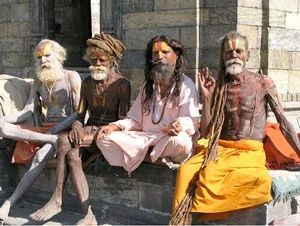
But, I must warn you this system is very ritualistic, with oddly specific requirements for each renunciate type — to the point of making this second step of renunciation seem more important than third step of actually meditating to attain the mystical union (which, in my opinion, is the only necessary step).
Regardless, because I already did all the research, I still decided to make a neat table with the 4 different types of renouncers. In case anyone wants to use it as a reference, for whatever purpose. Most of this information comes from the group of 20 Sannyasa (“renunciation”) Upanishads, such as Nāradaparivrājaka, Asrama, Bhiksuka, and others (Olivelle, 1992.).
Type of Renuciate or Ascetic | Name Etymology | Home | Possessions | Clothing | Hairstyle | Face Paint | Begging Style | Food Amount Generally | Fasting | Eating Style | Studying | Teaching |
Kuticaka | “One who lives in hut” | Small hut or cottage near family or village. | Walking stick, begging bowl, water bowl, small shovel, and small bag. | Loincloth, waistband, robe, shoes. | Shave head every season (around every 2 months). | 1 vertical white mark on their forehead | Begs only from the house of a single family member. | Can eat a full meal donated by someone. | None. | Uses a begging bowl. | Studying the Upanishads, particularly the meaning of the “Great Sayings.” | Not qualified to teach. |
Bahudaka | “Much water” | Homeless wanderer. | Walking stick, begging bowl, water bowl, small shovel, and small bag. | Loincloth, waistband, robe, shoes. | Shave head every other season. | 3 horizontal marks on forehead | Beg randomly from house to house, or person to person. Takes only a mouthful from each. | Eats only 8 mouthfuls. | None. | Uses a begging bowl. | Studying the Upanishads, particularly the meaning of the “Great Sayings.” | Not qualified to teach. |
Hamsa | “Swan” | Homeless wanderer. | Walking stick, water bowl, and small bag. | Loincloth, waistband, robe. | Not required to shave head, but if they do, they do it every 6 months. | 1 vertical mark + 3 horizontal marks on forehead | Beg randomly from house to house, or person to person. Takes only a mouthful from each. | Eats only 8 mouthfuls when they’re not fasting. | One day fast. Two day fast. The lunar fast (starting with 15 mouthfuls on full moon and decreasing by 1 mouthful a day till new moon). | Use hands. | Only reflective thinking in Meditation. | Not qualified to teach. |
Paramahamsa | “Supreme swan” | Homeless wanderer. | No posessions. | Loincloth, waistband, robe; or naked. | Not required to shave head, but if they do, they do it every 6 months. | Smeared ashes on face | Beg randomly from only 5 houses or people. Takes only a mouthful from each. | Don’t count mouthfuls (potentially). | No fasting. | Use hands. | Only reflective thinking in Meditation. | Teach meaning of the “Great Sayings” of the Upanishads. |
Turiyatita | “Beyond the fourth” (refers to 4th state of consciousness) | Homeless wanderer. | No posessions. | Completely naked. | Outgrown hair, they never shave. | Dot on forehead | Beg randomly from only 3 houses or people. Takes only a mouthful from each. | Don’t count mouthfuls (potentially). | No fasting. | Eat begged food directly from the ground, like an animal. | No more studying. | Teach meaning of the “Great Sayings” of the Upanishads. |
Avadhuta | “One who has shaken off” (all worldy desires & attachments) | Homeless wanderer. | No posessions. | Completely naked. | Outgrown hair, they never shave. | No face paint. | Don’t beg, they wait for people to leave food. | Don’t count mouthfuls (potentially). | No fasting. | No specific ritualistic way of eating (neither with bowl, hands, or on the ground) (they transcend all those rituals). | No more studying. | Teach meaning of the “Great Sayings” of the Upanishads. |
#3. Meditative Techniques (“Dhyana”) —
The third step is meditating on the mantra “OM.” This is a step that isn’t so clear in the Upansishads. There’s no detailed step-by-step guide for it so its been hard figuring out how it is actually done. Regardless, I’ll share what I’ve found so far, and if you’re curious, you can do more research.
“Aspiring to liberation, he should give up his body in a mountain cave, calling to mind the syllable OM.” – Nāradaparivrājaka Upanishad (Chapter 4, 169.) (Olivelle, 1992, p. 193.)